Worksheet 1 of 2
Correlation Considerations
Beta, correlation and hedge effectiveness for index and single stock futures hedges: the formulas, what weakens the correlation, and how to confirm beta.
Index and single stock futures can offset market and concentration risk while the shares stay in the portfolio. Correlation sizes the hedge and measures how much risk it actually removes.
A short futures position moves opposite the holdings it is sized against. Short E-mini S&P 500 and Nasdaq-100 futures offset broad market risk; short CME single stock futures offset a concentrated name. The result is a measured share of a decline absorbed by the hedge, with the shares still in place.
Add a short position instead of selling shares: no forced sale, and the long-term position stays intact.
Futures are margined at a fraction of notional value, so a large portfolio can be hedged without tying up equivalent cash. CME sets and updates the requirements.
ES and NQ for market and growth-tilted risk, micros (MES, MNQ at one-tenth size) to fine-tune, and 100-share single stock futures, with 10-share micros, for names an index does not cover.
Index futures trade nearly 24 hours a day, five days a week, with deep liquidity and central clearing, so risk can be adjusted outside cash-market hours.
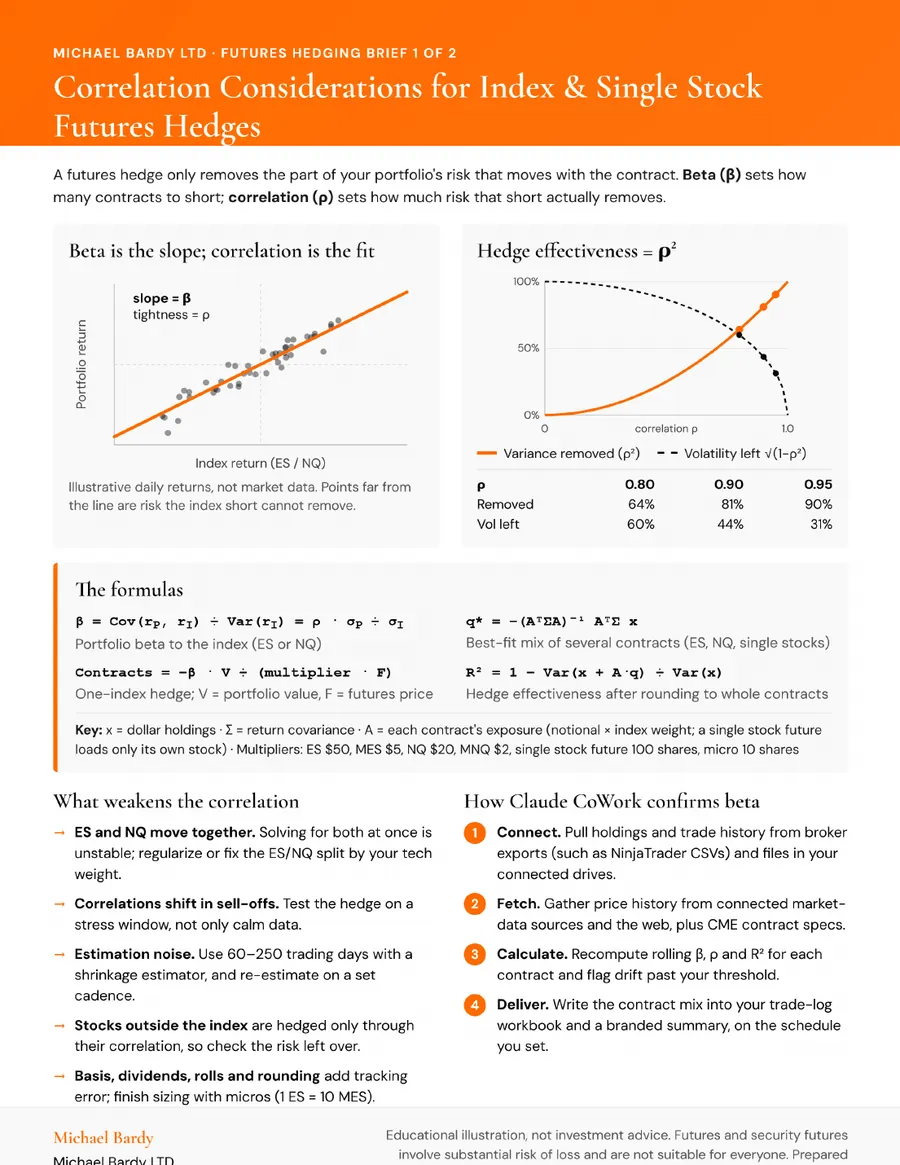
Beta decides how many contracts to short; correlation (ρ) decides how much risk that short removes. Hedge effectiveness is ρ², measured on past returns.
β = Cov(rP, rI) ÷ Var(rI) = ρ · σP ÷ σI
Contracts = −β · V ÷ (multiplier · F)
q* = −(AᵀΣA)⁻¹ AᵀΣ x
R² = 1 − Var(x + A·q) ÷ Var(x)
x = dollar holdings · V = portfolio value · F = futures price · Σ = return covariance · A = each contract's exposure (notional × index weight). Multipliers: ES $50, MES $5, NQ $20, MNQ $2; single stock future 100 shares, micro 10 shares.
| Measure | ρ 0.80 | ρ 0.90 | ρ 0.95 |
|---|---|---|---|
| Variance removed (ρ²) | 64% | 81% | 90% |
| Volatility left √(1−ρ²) | 60% | 44% | 31% |
Estimates use past returns. Correlations can shift in a sell-off, so test the hedge on a stress window as well as calm data.
A hedge works in both directions: gains on the hedged amount are given up. With correlation below 1, basis and stock-specific risk remain, and correlations can shift in a sell-off.
Futures settle gains and losses daily in cash, so a rally can mean margin calls on the short. Pricing embeds financing less dividends, and quarterly contracts must be rolled.
Exchange fees and commissions apply per contract. CME single stock futures launched on July 27, 2026 and trade far lighter volume than index futures, so spreads can be wider.
Index futures generally receive Section 1256 treatment; single stock futures generally do not. Hedging an appreciated position can raise straddle or constructive-sale questions. Consult a tax adviser.
Two one-page briefs. Open them in the browser or download them to keep.
Beta, correlation and hedge effectiveness for index and single stock futures hedges: the formulas, what weakens the correlation, and how to confirm beta.
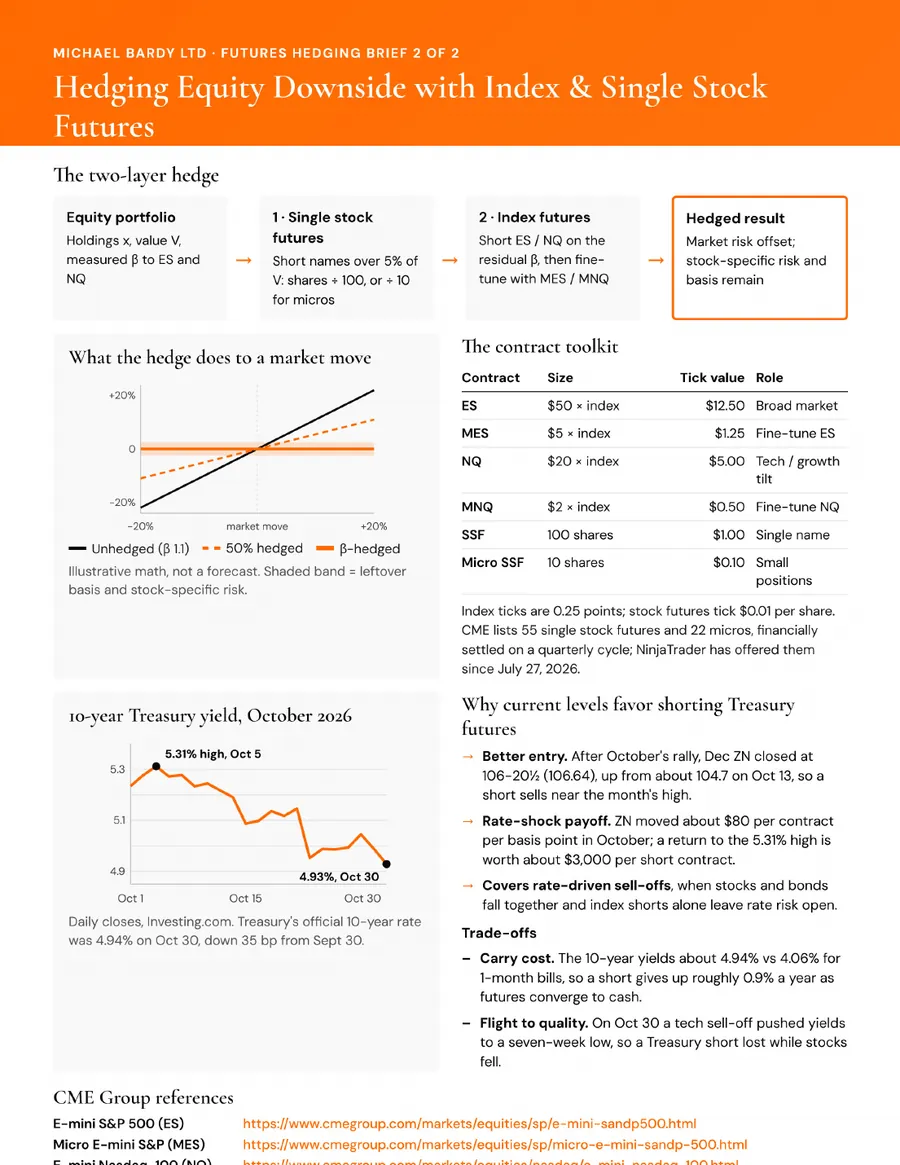
The two-layer hedge: single stock futures on concentrated names, index futures on the residual beta, the contract toolkit, and CME references.
Contract specifications, margin and fee schedules: CME Group (cmegroup.com). Educational illustration, not investment advice. Futures and security futures involve substantial risk of loss and are not suitable for everyone.